Insights
[Science Shot] ‘Dream’ Cancer Immunotherapy Upgrad
[Science Shot] ‘Dream’ Cancer Immunotherapy Upgraded by Rejuvenating Immune Cells to a Stem Cell-Like State
U.S. and Australian Research Teams Publish Separate Studies in Nature
Stem Cell-Inducing Proteins Boosted in CAR-T Cells
Animal Studies Show Improved Cancer-Killing Activity and Persistence
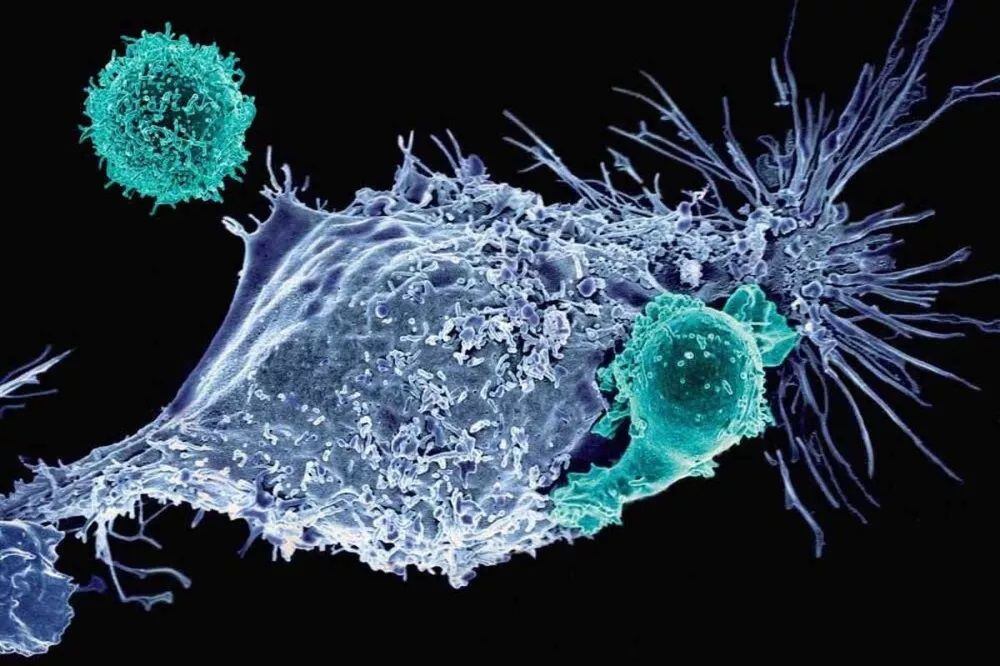
CAR-T cells (green) attacking cancer cells (blue).
Photo courtesy of Memorial Sloan Kettering Cancer Center
[Science Editor Lee Young-wan]
Published: April 11, 2024, 7:29 AM
Updated: April 11, 2024, 8:37 AM
There is a cancer therapy often described as a “living drug” and a “serial killer of cancer cells”: CAR-T cells, immune cells engineered to function as anticancer agents.
Scientists have now identified a way to make these immunotherapies even more powerful—by giving CAR-T cells stem cell-like characteristics.
Stem cells are primitive cells capable of developing into many different cell types in the body. By rejuvenating CAR-T cells toward a more stem cell-like state, researchers found that the engineered immune cells could achieve stronger and longer-lasting anticancer activity.

CAR-T cells, a form of cancer immunotherapy, gradually lose their anticancer activity over time. Researchers successfully rejuvenated the cells by enhancing the activity of a protein called FOXO1, restoring CAR-T cells that had become weakened like a flickering light bulb.
Image courtesy of Stanford University
Returning CAR-T Cells to a Stem Cell-Like State to Boost Therapeutic Potency
The international scientific journal Nature reported on the 10th that adding a protein that induces stem cell-like characteristics to personalized CAR-T cells can strengthen their cancer-killing activity and extend their persistence.
Research teams at Stanford University in the United States and Peter MacCallum Cancer Centre in Australia independently published studies in Nature demonstrating that rejuvenating CAR-T cells into a more stem cell-like state significantly enhances their anticancer activity.
CAR-T cell therapy works by genetically engineering T cells, key components of the immune system, so that they produce proteins capable of recognizing and binding to cancer cells. T cells are collected from a patient’s blood, modified to enhance their ability to recognize cancer, and then reinfused into the patient.
Although CAR-T therapies have shown strong efficacy against blood cancers such as leukemia, they have achieved much more limited success against solid tumors, including breast and lung cancers. Another major challenge is that CAR-T cells can become exhausted and lose their anticancer activity during prolonged battles with tumor cells.
Fewer than 50% of patients remain in complete remission one year after CAR-T treatment, in part because the engineered T cells often do not survive long enough in the body to completely eliminate the cancer.
Researchers in the United States and Australia have now identified a way to rejuvenate CAR-T cells by shifting them toward a stem cell-like state. Because these cells retain a more youthful cellular state, they can proliferate more rapidly and persist for longer periods after being administered.
Prof. Tuoqi Wu of UT Southwestern Medical Center commented in Nature that the studies “open a new avenue for enhancing therapeutic T cells for cancer patients.”

The CAR-T Cell Therapy Manufacturing Process
Image courtesy of the Malaghan Institute of Medical Research
Boosting a Rejuvenation Protein Revives Exhausted CAR-T Cells
Research teams led by Prof. Evan Weber of the Perelman School of Medicine at the University of Pennsylvania and Prof. Crystal Mackall of Stanford University School of Medicine compared CAR-T cells used to treat patients with leukemia. Some patients responded well to the immunotherapy, while others did not.
Genetic analysis showed that 41 genes were more highly active in T cells from patients who responded well to treatment than in cells from poor responders. The researchers found that all of these genes were regulated by a protein called FOXO1, suggesting that FOXO1 acts like a master switch controlling multiple cellular programs.
T cells help eliminate cells infected by pathogens or prevent them from proliferating, and they also support B cells that produce antibodies. After encountering a pathogen, some T cells remain in the body as memory T cells, enabling a rapid response if the same threat returns.
The researchers engineered CAR-T cells to produce higher levels of FOXO1. As a result, the cells acquired characteristics similar to stem cell-like memory T cells, which have regenerative properties that help sustain the memory T-cell population over long periods.
The team then administered FOXO1-enhanced CAR-T cells to mice with cancer. The modified CAR-T cells showed activity not only against blood cancers but also against solid tumors.
Compared with conventional CAR-T cells, the stem cell-like CAR-T cells reduced tumor burden more effectively and persisted longer in the body.

CAR-T cells (orange) attacking cancer cells (green). Scientists have rejuvenated CAR-T cells into a stem cell-like state, significantly enhancing their anticancer activity.
Eye of Science / Science Photo Library
Goal: Simultaneously Boost Two “Master-Switch” Molecules
A research team led by Prof. Phillip Darcy of the Peter MacCallum Cancer Centre in Australia also confirmed, using a different approach, that rejuvenating CAR-T cells can enhance their anticancer activity. The researchers focused on interleukins (ILs), signaling molecules involved in immune regulation. T cells that are effective against specific pathogens can differentiate into long-lived memory T cells under the influence of interleukin-15 (IL-15).
By analyzing gene activity in CAR-T cells, the researchers found that IL-15 activates genes associated with FOXO1. When CAR-T cells were engineered to produce higher levels of the FOXO1 protein, they not only acquired stem cell-like characteristics but also remained less susceptible to exhaustion as they matured, allowing them to continue fighting cancer.
FOXO1 also improved the metabolism of CAR-T cells, enabling them to maintain their anticancer effects for longer periods in mice.
The Australian research team said it plans to begin clinical trials in cancer patients within the next two years using CAR-T cells engineered to produce higher levels of FOXO1. The outlook is considered promising.
Previously, in 2019, Prof. Crystal Mackall of Stanford University School of Medicine identified another master-switch protein called c-Jun, which increases the persistence of CAR-T cells. This protein also helps T cells maintain their anticancer activity rather than becoming exhausted.
Prof. Evan Weber of the Perelman School of Medicine at the University of Pennsylvania is currently conducting a clinical trial in leukemia patients using CAR-T cells genetically engineered to overproduce c-Jun. Weber previously worked with Mackall as a postdoctoral researcher at Stanford University.
Mackall said, “The same system could also be applied to FOXO1,” adding that simultaneously enhancing both proteins could make CAR-T cells even more powerful.
References
Nature (2024)
DOI: 10.1038/s41586-024-07300-8
Nature (2024)
DOI: 10.1038/s41586-024-07242-1
Nature (2019)
DOI: 10.1038/s41586-019-1805-z