Insights
news
Biopharmaceuticals to Become Korea’s ‘Second Semic
2024-04-03
Biopharmaceuticals to Become Korea’s ‘Second Semiconductor Industry’ — Government to Support KRW 17.7 Trillion in Private Investment by 2030
Korea to Launch a ‘BioMADE’-Style Initiative to Secure Leadership in Advanced Biomanufacturing
MOU Signed to Strengthen Demonstration Support for Bio Organizations and Materials, Parts, and Equipment Suppliers — “Targeting USD 10 Billion in Exports”
Ministry of Trade, Industry and Energy Unveils Biomanufacturing Innovation Strategy at the 5th Strategic Meeting on Export Issues
- ▲ Photo courtesy of the Ministry of Trade, Industry and Energy
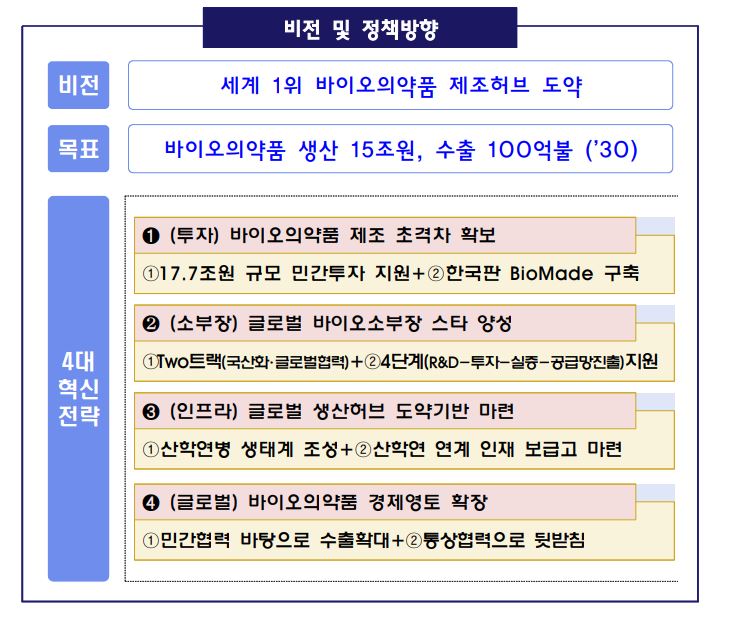
- The Korean government plans to support KRW 17.7 trillion in private investment by 2030 as part of its strategy to transform the country into the world’s leading biopharmaceutical manufacturing hub. Through these efforts, Korea aims to increase domestic companies’ biopharmaceutical production capacity to KRW 15 trillion and exports to USD 10 billion by 2030, positioning biopharmaceuticals as the country’s “second semiconductor industry.”
- On the 1st, the Ministry of Trade, Industry and Energy (MOTIE) unveiled its Biomanufacturing Innovation Strategy at a meeting on strengthening biomanufacturing competitiveness, held at the Startup Campus in Pangyo, Gyeonggi Province and chaired by Minister Ahn Duk-geun. The meeting also served as the 5th Strategic Meeting on Export Issues.
- Participants included leading biopharmaceutical companies such as Samsung Biologics and Celltrion, as well as companies specializing in bio-related materials, parts, and equipment, including Hanwha and Amicogen.
- According to MOTIE, the biotechnology industry is a major future growth engine expected to expand at an annual rate of around 10%, driven by factors such as pandemics and population aging. Major economies around the world are also introducing comprehensive strategies as competition intensifies to secure leadership in biomanufacturing.
- Backed by large-scale private-sector investment, Korea has already established the world’s second-largest biopharmaceutical manufacturing capacity.
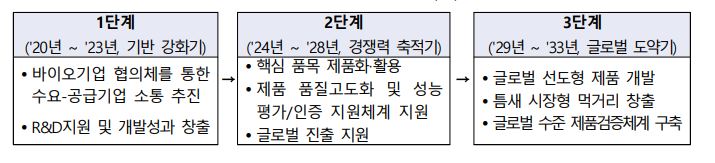
- ▲ Proposed Roadmap for Self-Reliance in Key Bio Materials, Parts, and Equipment
Source: Ministry of Trade, Industry and Energy - From this year through 2030, the Ministry of Trade, Industry and Energy (MOTIE) plans to provide KRW 2.1 trillion in government support for advanced biomanufacturing R&D, development of the bio materials, parts, and equipment ecosystem, industrial infrastructure, and global expansion. The initiative is designed to closely support KRW 17.7 trillion in private-sector investment by 2030 and secure a decisive competitive edge in advanced biomanufacturing.
- Through these efforts, the government aims to achieve KRW 15 trillion in biopharmaceutical production and USD 10 billion in biopharmaceutical exports by 2030, while fostering five globally competitive advanced biopharmaceutical CDMO companies and five leading global suppliers of bio materials, parts, and equipment.
- In particular, the government plans to launch a Korean version of BioMADE, a biomanufacturing innovation platform designed to advance next-generation biomanufacturing processes, following a preliminary feasibility study.
- The United States established BioMADE in 2020 as a collaborative research organization bringing together industry, academia, research institutions, and government to strengthen the country’s biomanufacturing capabilities.
- Korea also plans to strengthen cooperation with leading international organizations, including those in the United States, in connection with the public biofoundry scheduled to begin development next year. The goal is to help companies upgrade their manufacturing processes and accelerate commercialization.
- Prior to the meeting, the Bio Materials, Parts, and Equipment Alliance Cooperation Council signed an MOU to strengthen demonstration and validation support. Participants included major biopharmaceutical companies such as Samsung Biologics, Celltrion, and Samsung Bioepis, as well as research and training institutions including the Korea Research Institute of Bioscience and Biotechnology (KRIBB), the Osong Medical Innovation Foundation, and K-NIBRT, the Korea National Institute for Bioprocessing Research and Training.
- Through the alliance, participating companies and support organizations will establish testbeds for bio materials, parts, and equipment, providing full-scale support from this year to help domestic products build commercial track records. The government also plans to support demonstration and validation of 98 bio materials, parts, and equipment items, including testing and analysis according to internationally recognized standards.
- In July last year, the government unveiled its Bioeconomy 2.0 Strategy, which aims to expand Korea’s overall bioeconomy production to KRW 100 trillion by 2030 by fostering sectors including biopharmaceuticals, advanced biomaterials, bioenergy, and digital biotechnology.
- Minister Ahn said, “Biotechnology is both a future growth engine capable of becoming Korea’s second semiconductor industry and an essential industry for health security.”
- He added, “Through the establishment of a biomanufacturing innovation platform and the development of a strong domestic materials, parts, and equipment ecosystem, we will support Korea’s emergence as a global biomanufacturing hub.”