Press
1st Exosome Division Symposium of the Korean Socie
1st Exosome Division Symposium of the Korean Society for Stem Cell Research Successfully Held at Konkuk University
Symposium Highlights “Innovative Potential of Stem Cell Exosome Research”
More Than 200 Researchers and Industry Experts Gather to Share the Latest Scientific Advances
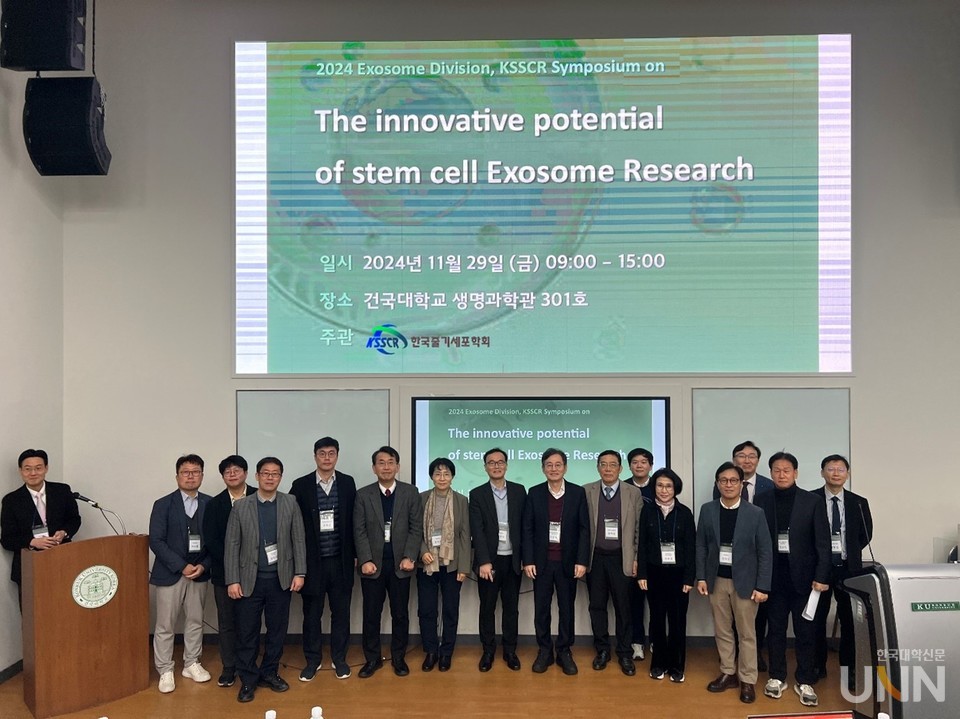
The 1st Exosome Division Symposium of the Korean Society for Stem Cell Research. (Photo courtesy of the Korean Society for Stem Cell Research)
[Korea University News Reporter Jung Soo-jung] The Korean Society for Stem Cell Research (KSSCR) held the inaugural symposium of its Exosome Division at Konkuk University on the 29th of last month.
Held under the theme “The Innovative Potential of Stem Cell Exosome Research,” the symposium brought together approximately 200 leading researchers and experts from Korea and abroad to share the latest scientific findings and innovative ideas in exosome research.
Presentations covered a wide range of topics, including the therapeutic potential of stem cell- and organoid-derived exosomes, strategies for standardization, and prospects for commercialization. Representatives from the Korea Regenerative Medicine Fund (KFRM), the Korea Health Industry Development Institute (KHIDI), the Life Sciences Division of the National Research Foundation of Korea (NRF), and the Korea Evaluation Institute of Industrial Technology (KEIT) also introduced major advanced biotechnology R&D programs and outlined future plans.
The symposium also featured discussions aimed at strengthening collaboration among academic societies, research institutions, and industry. Participants explored concrete strategies for the global standardization and commercialization of exosome technologies, while once again emphasizing the importance of active support from government agencies and industry, including the Ministry of Food and Drug Safety, the Ministry of Health and Welfare, and the Advanced Regenerative Medicine Committee.
In his opening remarks, Prof. Ssang-Goo Cho, Chair of the KSSCR Exosome Division and professor in Konkuk University’s Department of Stem Cell and Regenerative Biotechnology, said, “Exosome research is a key area that can help shape the future of life sciences and medicine. I hope this symposium will serve as a starting point for active exchange and collaboration among researchers.”
Congratulatory remarks were also delivered by Young-Beom Lee, Executive Vice President for External Affairs at Konkuk University and Director of the university’s Institute for Healthy Aging Society; In-Ho Kim, Director of the Korea Regenerative Medicine Fund; Dong-Ho Choi of Hanyang University, President of the Korean Society for Stem Cell Research; Wan-Seop Kim of Konkuk University, President of the Korean Society for Extracellular Vesicles; and Soo-Hong Lee of Dongguk University, Vice President of both the Korean Tissue Engineering and Regenerative Medicine Society and the Korean Society for Biomaterials. The speakers emphasized the contribution exosome research is expected to make to the advancement of regenerative medicine in Korea.
The event was supported by Konkuk University, StemExOne, Xcell Therapeutics, ENCell, Eul BioScience, Plandox, the Regenerative Medicine Center at Seoul National University Bundang Hospital, and the Korea Institute of Dermatological Sciences.
An official from the society said, “This symposium has laid the groundwork for stem cell exosome research in Korea to take another major step forward. The KSSCR Exosome Division will continue to provide a forum for collaboration between academia and industry through regular academic events and networking opportunities.”
The paracrine effect of stem cells is a key mechanism through which stem cells influence surrounding cells and plays a central role in their therapeutic activity. Exosomes, nanoscale extracellular vesicles secreted by stem cells, are considered one of the major mediators of this paracrine effect.
The KSSCR Exosome Division was established in October to promote stem cell-derived exosome research in Korea and internationally, and to represent the society in discussions and advisory activities related to exosome policies and regulatory issues.
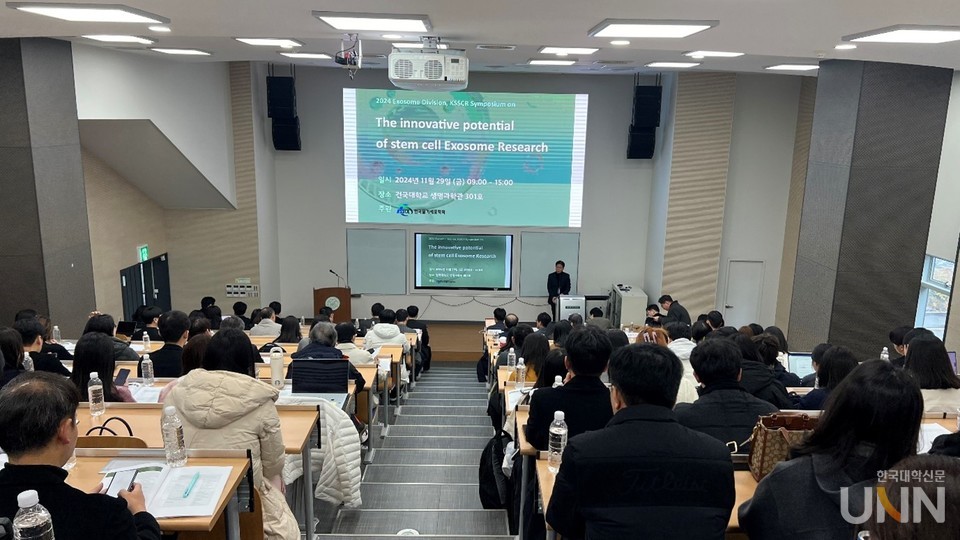
The 1st Exosome Division Symposium of the Korean Society for Stem Cell Research. (Photo courtesy of the Korean Society for Stem Cell Research)
Reporter Jung Soo-jung
crystal@unn.net