Press
[Konkuk University] AI-Driven Engineering Advances
[Konkuk University] AI-Driven Engineering Advances: Novel Peptide Developed Using AI-Based Protein Structure Prediction Models
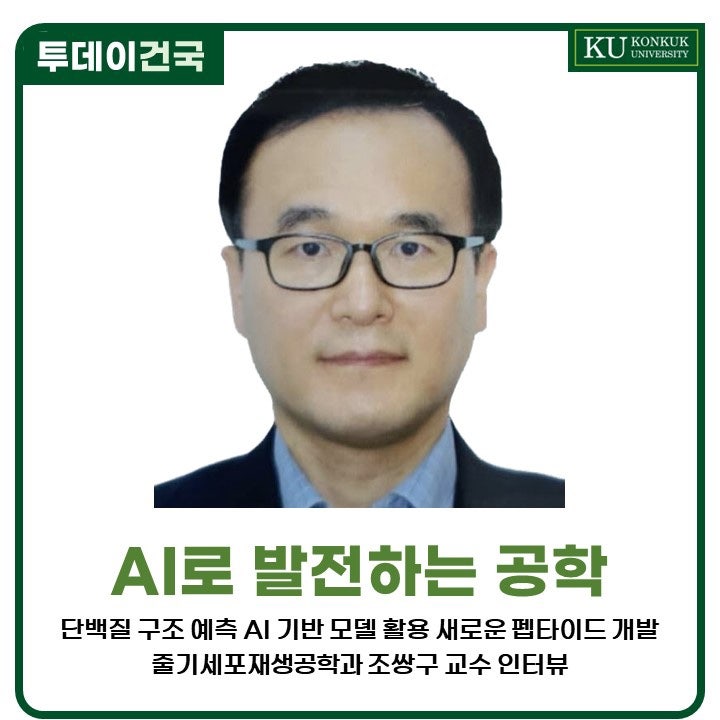
A research team led by Prof. Ssang-Goo Cho of Konkuk University’s KU Institute of Science and Technology and Department of Stem Cell and Regenerative Biotechnology has developed a fibroblast growth factor-2 (FGF-2)-derived peptide that enhances stem cell growth and shows potential for improving osteoarthritis treatment. The team used an AI-based model capable of predicting the three-dimensional structure of proteins.
The findings were published in the Journal of Advanced Research (Impact Factor 10.7) and were also featured in the Biological Research Information Center’s “Korean Scientists Who Shine” program.
Prof. Cho serves as Chairman of the Korean Society for Stem Cell Research and CEO of StemExOne, and previously served as Director of the KU Institute of Science and Technology at Konkuk University. Today Konkuk shares his story and his continued efforts to advance education and research.
We understand that you developed a novel peptide using an AI-based model for three-dimensional protein structure prediction. Could you tell us about the research?
“Proteins play central roles in regulating a wide range of physiological functions in the human body. While the amino acid sequence of a protein is important, its three-dimensional structure, which is determined by that sequence, is particularly critical.
“Protein structures are extremely complex, which makes it very difficult to obtain all the necessary data through experiments alone. That is why we are now integrating AI into our research.
“We conducted this study using AlphaFold2, developed by Google DeepMind. As AI continues to advance, I believe it will eventually surpass many conventional experimental approaches performed by humans. AlphaFold2 is, in my view, one of the most advanced examples of the convergence of AI and biotechnology.
“We used AlphaFold2’s protein structure prediction system to analyze how proteins change structurally in response to cellular signals. When a cell receives a signal, the structure of certain proteins changes into a specific conformation, and these changes help regulate physiological processes in the body.
“Our goal is to determine which substances trigger these signaling responses. Traditionally, this type of research requires enormous amounts of time, funding, and manpower. AI technology has allowed us to reduce those burdens significantly.”
What are your thoughts on the adoption of AI technologies in engineering?
“In the past, I did not rely much on AI because the information it provided was not always accurate. But AI is becoming increasingly sophisticated over time. I believe we will see far greater use of AI for pattern analysis and similar applications in the future.
“To reach a meaningful result, researchers often need to run an enormous number of simulations. It is simply unrealistic for people to handle all of them manually. AI can help filter out unnecessary results and significantly improve the efficiency of the research process.
“AI also continues to learn from the simulations we run and the information we provide. I believe this will ultimately make AI an even more powerful experimental tool.”
How is AI currently being used in Konkuk University’s Department of Stem Cell and Regenerative Biotechnology?
“We use AI in a variety of ways, particularly in research involving undergraduate students.
“Culturing stem cells can take six months to a year before students are able to begin their own experiments. Computational research, on the other hand, can begin immediately. Younger students today are often much more comfortable with computers than I am,” he said with a laugh.
“So, I want to first teach students experiments and research methods that can be carried out on computers. They can then gradually learn other laboratory techniques as their research progresses.
“Because much of our work involves living biological materials, experiments require continuous attention. If cells are not properly maintained, they can die or lose functionality. It is difficult for undergraduate students to manage this while also keeping up with their coursework. That is why I often encourage them to begin with AI-based research.
“I believe that, in the future, robots will perform many laboratory experiments. We are moving toward an era in which generating good ideas will become far more important than simply carrying out experiments.
“In our laboratory, Dr. Ahmed Morsy and Ph.D. candidate Soo Bin Lee are actively involved in AI-related research. When necessary, we also collaborate with AI specialists in Korea and abroad.
“For example, in our recent study on the development of an FGF-2-derived peptide, published in the Journal of Advanced Research (IF 10.7), we collaborated with Prof. Sebastian Kmiecik of the University of Warsaw in Poland, who developed CABS-Doc, a computational program for modeling protein–peptide interactions.”
You also serve as CEO of StemExOne, a subsidiary of Konkuk University Holdings. Could you introduce the company?
“I wanted to use stem cell research to develop therapeutics and other technologies that could ultimately benefit people. I had a strong desire to collaborate with companies, and I realized that development could move much more efficiently if we established a company of our own.
“That is why I founded a venture company—to create the basic infrastructure needed to commercialize therapeutics and other technologies developed through stem cell research, while also pursuing joint development with other companies.
“In fact, I created the company in order to become a better professor. I believe a professor has three major responsibilities: education, research, and service. The practical experience gained from operating a company can be extremely valuable in fulfilling those roles.
“There are lessons that can only be learned through real-world business experience, and I wanted to share those experiences with my students.
“StemExOne is also a subsidiary of the university’s holding company, with Konkuk University participating as a shareholder. So if the company grows successfully, the university also benefits,” he added with a smile.
You previously served as Director of the KU Institute of Science and Technology. What is your vision for the institute?
“I believe one of the defining themes of our time is convergence. My own research, which combines AI with biotechnology, is a good example.
“The KU Institute of Science and Technology was created to foster that kind of interdisciplinary convergence. In reality, however, convergence is very difficult. It requires you to entrust areas you do not fully understand to people who are experts in those fields.
“Learning an entirely unfamiliar discipline yourself can take far too much time. A more effective approach is to collaborate with people who already excel in those areas.
“That is why I believe students should be given many more opportunities to work across disciplines. The most efficient form of convergence may actually happen among students within the university.
“In some ways, interdisciplinary collaboration among students could be even more powerful than collaboration among professors, because students can carry those experiences forward as they grow and continue creating new outcomes throughout their careers.”
You currently serve as Chairman of the Korean Society for Stem Cell Research. Could you tell us about the organization?
“The Korean Society for Stem Cell Research (KSSCR) is Korea’s leading academic society in the field of stem cell research.
“We maintain active exchanges with the International Society for Stem Cell Research (ISSCR) and also collaborate with stem cell societies in countries such as Japan, China, and Singapore through regional research networks.
“Korea has significant strengths in the field of advanced regenerative medicine. We are working to ensure that Korea can remain at the forefront of this area.
“Another important goal is to help stem cell-based therapeutics reach patients more quickly so that advances in research can translate into tangible benefits for society.”
Do you have a message for the Konkuk University community?
“Konkuk University has grown tremendously across many fields, but biotechnology is one of its particular strengths.
“Our university has a medical center, a veterinary medical center, and even a senior living community nearby. The KU Institute of Science and Technology is located right in the middle of this ecosystem.
“That gives us a highly competitive environment in which research findings can be connected directly to real-world applications. It also creates strong opportunities for attracting investment and translating research into practical outcomes.
“I hope students at Konkuk University will take the initiative, explore a wide range of research opportunities, and create meaningful achievements of their own.”
Planning and Production: Baek Ha-eun, 11th Today Konkuk Editorial Team