Insights
What Changes Under the Revised Advanced Regenerati
What Changes Under the Revised Advanced Regenerative Medicine Act?

The Act on the Safety of and Support for Advanced Regenerative Medicine and Advanced Biopharmaceuticals, commonly referred to as the Advanced Regenerative Medicine Act, took effect in August 2020. The law was introduced to ensure the safety of advanced regenerative medicine, promote technological innovation and commercialization, and strengthen quality control for advanced biopharmaceuticals.
Cell and gene therapies, which can help regenerate damaged tissues or organs, are among the most representative forms of advanced regenerative medicine. In Korea, however, their use had largely been limited to clinical research involving patients with severe, rare, or intractable diseases. As a result, the scope of application remained highly restricted, despite the law’s original purpose of promoting advanced regenerative medicine.
This limited access led some patients to seek treatment overseas, including in countries such as Japan, where certain stem cell-based procedures may be provided under different regulatory frameworks.
After four years of limited practical impact due to strict regulations, the law was revised. The amendment passed the National Assembly plenary session on February 1, 2024, drawing renewed attention to cell-based therapies.
Under the revised framework, Korean cell therapy companies are expected to gain greater opportunities to expand clinical research and development. The changes are also expected to open the door for approved regenerative medical treatments to generate revenue through patient care, potentially accelerating the commercialization of advanced cell therapies in Korea.

General Patients Will Also Be Eligible to Participate in Clinical Research
One of the key changes under the revised Advanced Regenerative Medicine Act is the expansion of eligibility for clinical research. Previously, participation was limited to patients with serious, rare, or intractable diseases. Under the revised law, the scope has been broadened, allowing general patients who meet the applicable criteria to participate in advanced regenerative medicine clinical research.
Treatment May Be Available for Diseases with No Alternative Therapy
A new advanced regenerative medicine treatment framework will also be introduced. Previously, cell and gene therapies could generally be used for treatment only after receiving formal approval as pharmaceutical products.
Under the revised law, however, cell and gene therapies that are still in the clinical development stage may be used for treatment if there is no alternative therapy available, or if the patient has a serious, rare, or intractable disease, provided that the relevant review committee approves the safety and treatment plan.
For example, once the revised law takes effect, patients with glioblastoma may have an opportunity to receive CBT101, an immune cell therapy currently being developed by CHA Biotech.
CBT101 targets glioblastoma, a type of brain tumor. Although the therapy is still undergoing clinical development, glioblastoma falls within the category of serious, rare, and intractable diseases for which no adequate alternative treatment is available, meaning that treatment could potentially be provided under the revised framework.
CBT101 demonstrated safety and tolerability in a Phase 1 clinical trial in Korea in 2022 and is currently being prepared for multinational clinical trials. In September 2020, the therapy also received Orphan Drug Designation (ODD) from the U.S. Food and Drug Administration (FDA) for malignant glioma.
Expansion of Medical Institutions Eligible to Provide Cell and Gene Therapies
The licensing requirements for businesses that manage human cells and related materials will also be eased. These businesses collect, import, test, or process human cells and supply them as raw materials for advanced biopharmaceutical products.
Under the revised law, therapeutic products used in advanced regenerative medicine must be manufactured at cell-processing facilities licensed to manage human cells and related materials. However, advanced regenerative medicine institutions that possess facilities, equipment, and personnel meeting standards comparable to those required for such licenses may be deemed to hold the relevant authorization.
As a result, the number of licensed human cell management institutions is expected to increase from around 30 to approximately 100.
Medical institutions designated to provide advanced regenerative medicine will also be permitted to perform minimal manipulation of patient-derived cells, such as simple isolation, washing, freezing, and thawing, and supply them as source materials for advanced biopharmaceutical products.
In practical terms, 85 medical institutions had been designated as advanced regenerative medicine institutions as of December 2023, and patients may be able to receive eligible cell and gene therapies through these institutions under the revised regulatory framework.
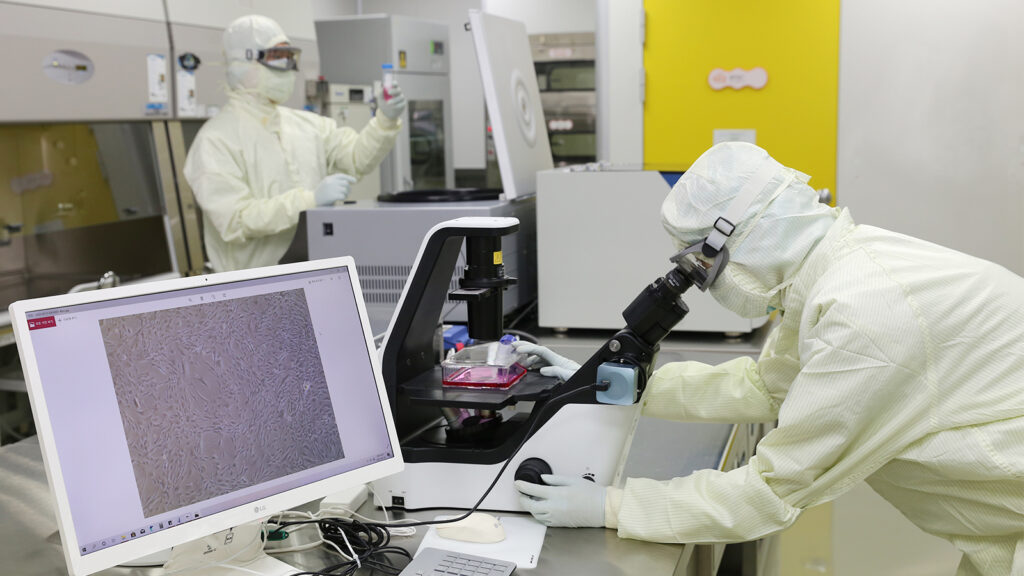
<CHA Biotech obtained a license to manufacture advanced biopharmaceuticals in December 2020. It subsequently secured licenses for human cell management and cell-processing facilities, becoming the first company in Korea to obtain all three authorizations.>
Korea’s CGT Market Reaches KRW 120 Billion — Revised Advanced Regenerative Medicine Act Expected to Accelerate R&D
According to the Biopharmaceutical Industry Trends Report published by the Korea Biopharmaceutical Industry Association, Korea’s cell and gene therapy (CGT) market was valued at KRW 115.5 billion in 2022, up 37.8% from KRW 83.9 billion in 2021.
In the same year, Korea’s overall biopharmaceutical market reached KRW 5.1663 trillion, with CGT accounting for approximately 2.2% of the total.
Although CGT still represents a relatively small share of the overall biopharmaceutical market, ongoing clinical trials are progressing steadily and a growing number of companies are entering the field.
In particular, the passage of the revised Advanced Regenerative Medicine Act by the National Assembly is expected to provide further momentum for CGT research, development, and commercialization.
— The remainder of the article is omitted. —